Brilliant Al.chemy
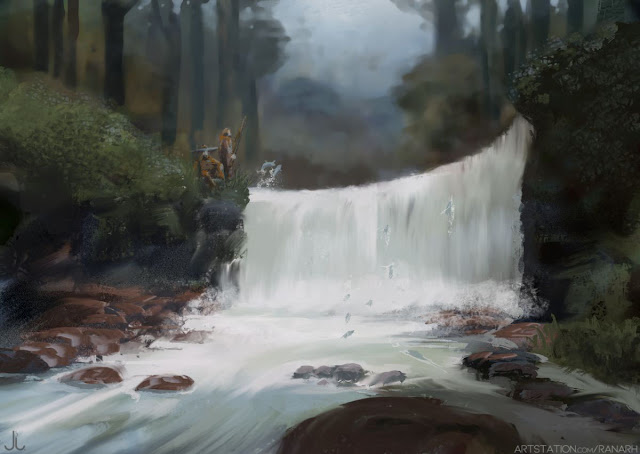
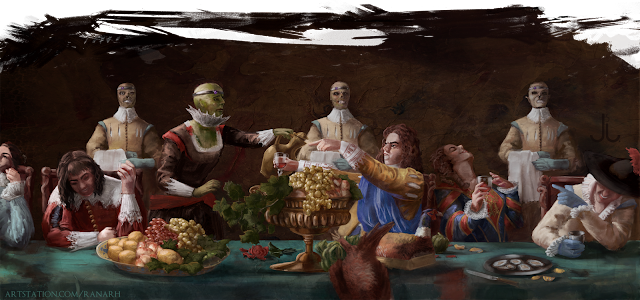
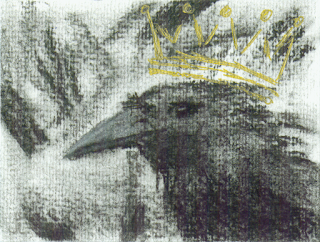
I've recently discovered the sketching software Al.chemy for myself. Sometimes I paint on the base of a collage of plenty of gradients, structures, and textures, then draw a sketch on top and develop a painting from it, but Al.chemy can do all that in a much more random way, plus nice recording functions. Here are some of the sketches I created with Al.chemy; the cityscape has had a little touch-up in Photoshop.
Al.chemy is an open source software and it's free to use. You can download it on http://al.chemy.org/
Ranarh's Art Blog
Monday, May 7, 2012
Thursday, April 19, 2012
Genius Loci races: Garren
The lizard people of Kitas are called garren, or singular gar. Don't be irritated by the race template, they normally wear clothes. Their long tail is flexible, if clumsy, and can be used as a weapon, mostly they drag it on the ground. Smaller body parts like the tail or fingers can be grown back, although it takes several months. Garren can have practically any colour and pattern; they can change it by eating certain foods, and after a little while they change in appearance. The patterns are never quite certain. The crest is covered in soft thin scales and flexible between stabilizing spikes. Garren have quick reflexes and lots of stamina; since they are also cold-blooded, they prefer the southern region and are most common in northern Lozir, but can be found anywhere.
Psychologically, garren are impulsive and usually the first to act. They tend towards polarized views; because of the trouble the combination can get them in garren are often found in voice houses getting counsel before deciding anything big. On the positive side, life isn't boring with garren around; while they can be incredibly lazy, they like sports and love to experiment.
Labels:
concept art,
Genius Loci
Wednesday, April 11, 2012
Genius Loci races and cultures
I think of Genius Loci as a world of its own and not a sibling to earth - different but the same - an especially not in any medieval terms, like cold dark castles, muddy streets, and dirty people, but not in unproblematic high fantasy terms either.
The peoples of the setting are the classical races - there are humans and elves, dwarves and lizard people - but I also invented some races that have not appeared elsewhere, and the "classics" are a little different, as are the relations between them. I am often bored with stereotypes and try to avoid them in my own creations. For example, elves and dwarves are not at odds, but in fact friendly towards each other since both are long-lived; elves are not superior. There are other creatures that take the place of the traditionally mysterious elves; the elves themselves are very down-to-earth, because I am bored with the overly powerful, overly magical, overly beautiful guys you meet in every fantasy forest. Many of the creatures will be removed from what we know as well.
What will probably make the biggest difference to most settings I have come to know is that not the race defines a person's culture, but their origin. Two dwarves meeting will not have common ground unless they are from the same place; there are no such things as "dwarven lands" or "human realms". While some countries have so many of one race that the country's language might be called "elvish", and of course larger numbers influence the minorities, the fact remains that people's culture and race are not linked. Just as we here live with the fact that not everyone is the same height, or some people have impairments, people on Kitas live with neighbours that can fly, or a shopkeeper who has been around for centuries.
The peoples of the setting are the classical races - there are humans and elves, dwarves and lizard people - but I also invented some races that have not appeared elsewhere, and the "classics" are a little different, as are the relations between them. I am often bored with stereotypes and try to avoid them in my own creations. For example, elves and dwarves are not at odds, but in fact friendly towards each other since both are long-lived; elves are not superior. There are other creatures that take the place of the traditionally mysterious elves; the elves themselves are very down-to-earth, because I am bored with the overly powerful, overly magical, overly beautiful guys you meet in every fantasy forest. Many of the creatures will be removed from what we know as well.
What will probably make the biggest difference to most settings I have come to know is that not the race defines a person's culture, but their origin. Two dwarves meeting will not have common ground unless they are from the same place; there are no such things as "dwarven lands" or "human realms". While some countries have so many of one race that the country's language might be called "elvish", and of course larger numbers influence the minorities, the fact remains that people's culture and race are not linked. Just as we here live with the fact that not everyone is the same height, or some people have impairments, people on Kitas live with neighbours that can fly, or a shopkeeper who has been around for centuries.
Labels:
Genius Loci
Friday, March 30, 2012
Map Creation II
I scan the maps in two pieces each and puzzle them together in Photoshop. Taking a moment to set the scanner up correctly will save you a lot of work later; I only need to regulate the contrast a little and have nice outlines. Still, I go over every line zoomed in closely to fix up all errors, like smudges and grey areas.
For a first printable version, I put all maps on the same format, add a border and name - and look, a previously mediocre scribble looks totally professional all of a sudden ;)
If you are happy with the map like this, think about using different font-styles for the features, like italic for mountains. Let the names follow the direction of the map feature, but don't put them in too wildly or the map will be hard to read.
For a first printable version, I put all maps on the same format, add a border and name - and look, a previously mediocre scribble looks totally professional all of a sudden ;)
If you are happy with the map like this, think about using different font-styles for the features, like italic for mountains. Let the names follow the direction of the map feature, but don't put them in too wildly or the map will be hard to read.
Labels:
Genius Loci,
tutorial,
Walkhrough
Thursday, March 29, 2012
Genius Loci: Concerning wempons
The beasts called wempons were among the first concepts I stuck with when I began developing Genius Loci years ago, and their design has never changed much. My main inspirations were anteaters, watussi cattle, and pangolins, but there's a bit of elephant and camel in it too, the latter mainly in their behaviour.
Wempons have large burrowing claws they can also use for climbing (yes, there are trees on Kitas that can carry a beast of almost four tons). Their muscular tails can grab, although they are not very dextrous. They are mostly vegetarian, preferring leaves, fruit, and roots, but also eat bugs and the likes. Thick scales protect their upsides, long thick fur the underside, their horns are enormously long - riders climb their mount holding on to them or stepping on a bent leg.
They are great mounts if one can get along with them. Wempons are picky about riders and hard to get used to being rented; usually they belong to a single rider. They need additional training to serve as packing animals, but can then carry great loads. Some nomad peoples have herds of them packed with the contents of an entire village worth of belongings. Wempons don't like having things dangle over their legs, so the riders' legs have to be out of the way and are pulled up on the saddle.
Being sent to herd the wempons is among the least favourite jobs for youngsters; the beasties will push them around and be hard to look after. On the other hand, it's a good way to become friends with one that will be a loyal mount later.
Wempons have large burrowing claws they can also use for climbing (yes, there are trees on Kitas that can carry a beast of almost four tons). Their muscular tails can grab, although they are not very dextrous. They are mostly vegetarian, preferring leaves, fruit, and roots, but also eat bugs and the likes. Thick scales protect their upsides, long thick fur the underside, their horns are enormously long - riders climb their mount holding on to them or stepping on a bent leg.
They are great mounts if one can get along with them. Wempons are picky about riders and hard to get used to being rented; usually they belong to a single rider. They need additional training to serve as packing animals, but can then carry great loads. Some nomad peoples have herds of them packed with the contents of an entire village worth of belongings. Wempons don't like having things dangle over their legs, so the riders' legs have to be out of the way and are pulled up on the saddle.
Being sent to herd the wempons is among the least favourite jobs for youngsters; the beasties will push them around and be hard to look after. On the other hand, it's a good way to become friends with one that will be a loyal mount later.
Labels:
concept art,
Genius Loci
Wednesday, March 21, 2012
Map Creation I
I wanted to share some of the things I thought you might find useful for the creation of fantasy maps. The examples are from my own fantasy world "Genius Loci".
First things first: Decide how the world will look, and how big the map will be, geographically. If you are creating an entire world like I am, start with the continents. The very first layout can be however messy you want, but then get some large paper (the line sketch is on A3. I already marked some major topographical landmarks).
Mark the general shape of the continent lightly with a pencil, then draw the land. Just wiggle your pen while you make your way around the landmass. Don't forget interesting shapes, like bays, islands, peninsulas, and so forth. It doesn't have to work all at once; you can go over the outlines as many times as you need until you're satisfied. I imagine there to be a much larger amount of islands later, but these are as small as I want to see on this scale.
I trace the contours of the continent with a .3 pigmented pen and add the inner borders with a .1 pen, on architect's vellum. I already know the states and lands with name and position from an earlier map. But, the continent is also very dry and covered in deserts. So, I rip off another piece of vellum, and using a blue marker lay down the rivers and water bodies. Around these, I arrange the states. Now everyone has access to water, which is one of the most important factors for settlements.
Write down a list of your states. Learn a little geology - how do mountains affect vegetation, which path do weather phenomena take and such. It will probably influence your world.
First things first: Decide how the world will look, and how big the map will be, geographically. If you are creating an entire world like I am, start with the continents. The very first layout can be however messy you want, but then get some large paper (the line sketch is on A3. I already marked some major topographical landmarks).
Mark the general shape of the continent lightly with a pencil, then draw the land. Just wiggle your pen while you make your way around the landmass. Don't forget interesting shapes, like bays, islands, peninsulas, and so forth. It doesn't have to work all at once; you can go over the outlines as many times as you need until you're satisfied. I imagine there to be a much larger amount of islands later, but these are as small as I want to see on this scale.
I trace the contours of the continent with a .3 pigmented pen and add the inner borders with a .1 pen, on architect's vellum. I already know the states and lands with name and position from an earlier map. But, the continent is also very dry and covered in deserts. So, I rip off another piece of vellum, and using a blue marker lay down the rivers and water bodies. Around these, I arrange the states. Now everyone has access to water, which is one of the most important factors for settlements.
Write down a list of your states. Learn a little geology - how do mountains affect vegetation, which path do weather phenomena take and such. It will probably influence your world.
Labels:
Genius Loci,
tutorial,
Walkhrough
Wednesday, March 7, 2012
Introducing Genius Loci
Over the last decade I have been thinking about my own world, but never took a longer time period to work on it seriously. That time has come now. Prepare to enter a world filled with mysteries.
Genius Loci is a setting spanning an entire planet. From the endless forests of the contintent Gdera to Sawa's volcanic wastelands to the vast deserts of Lozir, mysteries from ages past lay scattered in lands that have not been traveled since the ancient times. Places of magical puzzles are populated by spirits of nature or those of the dead; ghostly figures roam their former homes, while the most powerful spirits' domains cannot be entered without protection. The mages and wizards, while hunting the same goal, will wage war on each other at even a slight provocation.
It is a place where strange customs await the traveler. Never be too sure what to expect around the corner.
Some of the races and landscapes of Genius Loci will be familiar, while others are entirely new. I have a lot of fun inventing cultures and places of power, just as I love coming up with epic landscapes and striking portraits, and I expect this project will keep me busy for quite some time. Most things will be published on my website, but in this blog I'll make room for explanations, descriptions, and background, so check in regularly.
Genius Loci is a setting spanning an entire planet. From the endless forests of the contintent Gdera to Sawa's volcanic wastelands to the vast deserts of Lozir, mysteries from ages past lay scattered in lands that have not been traveled since the ancient times. Places of magical puzzles are populated by spirits of nature or those of the dead; ghostly figures roam their former homes, while the most powerful spirits' domains cannot be entered without protection. The mages and wizards, while hunting the same goal, will wage war on each other at even a slight provocation.
It is a place where strange customs await the traveler. Never be too sure what to expect around the corner.
Some of the races and landscapes of Genius Loci will be familiar, while others are entirely new. I have a lot of fun inventing cultures and places of power, just as I love coming up with epic landscapes and striking portraits, and I expect this project will keep me busy for quite some time. Most things will be published on my website, but in this blog I'll make room for explanations, descriptions, and background, so check in regularly.
Labels:
Genius Loci
Subscribe to:
Posts (Atom)